

Last Updated: November 24, 2026
Quick Summary
Candles lose fragrance for three main reasons: the volatile fragrance oils evaporate into the air over time, the wax degrades, and the wick underperforms. Air, light and heat all speed up scent loss, so a candle left open on a sunny windowsill will fade faster than one kept in a cupboard.
- Fragrance oils are volatile and evaporate even when the candle is not burning, so keep the lid on.
- Citrus and light floral notes fade fastest, while heavier notes like patchouli and amber hold on longer.
- Trim the wick to 5mm before every burn to avoid a weak, flickering flame.
- Fragrance needs 20-30 minutes of burning to build a full melt pool and release properly.
- Store candles cool, dark and upright, away from radiators, steamy bathrooms and freezing sheds.
Table of Contents
- Cold Throw vs Hot Throw: Why Your Candle Smells Different Lit and Unlit
- Why Do Candles Lose Fragrance Over Time? The Main Causes
- Why Does My Candle Have No Scent Throw? A Step-by-Step Diagnosis
- How to Make a Candle Smell Stronger Without Wasting Wax
- How to Store Scented Candles to Keep Their Fragrance
- How Long Do Scented Candles Last? Shelf Life and Burn Time
- Frequently Asked Questions
Cold Throw vs Hot Throw: Why Your Candle Smells Different Lit and Unlit
If you've ever wondered why candles lose fragrance the moment the flame catches, you're not imagining it. Cold throw is the scent a candle gives off before it's lit; hot throw is what it releases once the wax melts.
A strong cold throw tells you the fragrance oil is present, not that the candle will fill a room. Many candles smell wonderful in the tin and faint once burning.
What Cold Throw Tells You Before You Light Up
Cold throw is your first impression. It's the scent you get when you lift the lid or sniff the wax.
It's useful, but limited: a candle can have a bold cold throw and a weak hot throw.
Use cold throw to check whether you like the scent profile, not to judge how the candle will perform in your living room.
Why Hot Throw Is the Real Test of a Candle
Hot throw is what you actually paid for. It's the fragrance released when the melt pool forms and the wax reaches the right temperature.
This is where cheap candles fall apart.
If you want to see what a strong hot throw looks like in practice, it helps to compare well-reviewed luxury candles side by side before you buy.
Why Do Candles Lose Fragrance Over Time? The Main Causes
Candles lose fragrance for three main reasons: the oils evaporate, the wax degrades, and the wick underperforms.
Fragrance Oil Evaporation and Degradation
Fragrance oils are volatile, they evaporate into the air over time, even when the candle isn't burning.
A candle left open to the air will slowly lose its scent. Citrus and light floral notes fade fastest. Heavier notes like patchouli and amber hold on longer.
Air, Light and Temperature Changes
Air, light and heat all speed up scent loss. A candle on a sunny windowsill will fade faster than one in a cupboard.
Temperature swings matter too. A candle that melts and re-solidifies repeatedly can develop a dull, uneven surface and a weaker scent.
Fragrance Load, Wax Compatibility and Wick Performance
Fragrance load is the amount of fragrance oil in the wax.
The wax matters just as much. Soy wax holds fragrance differently to paraffin, and some oils bind better to certain waxes.
Then there's the wick. A wick that's too small won't melt enough wax to carry the scent.
At HappyNose Candles, every wick is centred for this reason.
If you make your own candles and want to test this yourself, you can pick up a quality fragrance oil and experiment with different loads.
Why Does My Candle Have No Scent Throw? A Step-by-Step Diagnosis
Before you blame the candle, run this diagnostic. It separates a genuine candle problem from a nose problem and tells you which fix to try first.
Step 1: Rule Out Scent Adaptation
Scent adaptation, sometimes called olfactory fatigue, is the most common reason people think a candle has lost its fragrance. Your nose simply stops registering a smell after prolonged exposure.
The fresh-room test: Leave the room for at least ten minutes, ideally fifteen, and go somewhere with different air. When you return, notice whether the scent is obvious again. If it is, your candle is working and your nose had adapted.
The second-person test: Ask someone who has not been in the room to step in and tell you whether they can smell the candle.
Step 2: Check the Cold Throw
With the candle unlit and the lid off, smell the wax directly. If the cold throw is still strong, the fragrance oil is present and the problem is in the burn. If the cold throw is also weak or absent, the candle has likely lost fragrance through storage or age, skip to Step 4.
Step 3: Diagnose the Burn
If the cold throw is fine but the hot throw is weak, the issue is in how the candle burns. Check these in order:
- Wick length. A wick longer than about 5mm will mushroom and burn too fast, giving a weak, flickering flame that releases less fragrance. Trim to 5mm before every burn.
- First-burn tunnelling. If the wax did not melt all the way to the edge on the first burn, the candle has tunnelled. It will never burn past that point, and the wick will sit in a narrow well with too little melted wax to carry scent. This is permanent, no amount of trimming will fix it.
- Burn time. Fragrance needs 20-30 minutes of burning to build a full melt pool and release properly. A candle that smells faint after five minutes may be fine.
- Room size and draughts. A candle that fills a bedroom will not fill an open-plan living area. Draughts from windows, doors or fans pull scent away before it accumulates. Close the door and eliminate draughts before judging the throw.
- Wick position. An off-centre wick burns unevenly and leaves wax unmelted on one side, wasting fragrance. This is a manufacturing fault and cannot be fixed.
Step 4: Check for Genuine Fragrance Loss
If the cold throw is weak and the candle has been stored for a long time, the fragrance oil has likely evaporated or degraded.
Watch out: never add fragrance oil to a finished candle or overheat it to try to restore scent. Adding oil to a poured candle disrupts the wax structure and creates a fire hazard, and overheating wax can cause it to catch fire or release fumes.
Quick Decision Summary
- Smells fine to someone else, or after leaving the room? Scent adaptation, no fix needed.
- Strong cold throw, weak hot throw? Burn problem, check wick, tunnelling, burn time and draughts.
- Weak cold throw and old candle? Fragrance loss, replace it.
This flow catches the two most common misdiagnoses: blaming the candle for scent adaptation, and blaming the nose for a tunnelled wick.
Here is the diagnostic in brief, from the symptom to the likely cause and the fix.
| Symptom | Likely cause | What to do |
|---|---|---|
| Smells fine after leaving the room | Scent adaptation | No fix needed |
| Someone new to the room can smell it | Scent adaptation | No fix needed |
| Strong cold throw, weak hot throw | Burn problem | Check wick, tunnelling, burn time and draughts |
| Wick longer than about 5mm | Mushrooming, weak flame | Trim to 5mm before every burn |
| Wax did not melt to the edge on first burn | Tunnelling | Permanent, cannot be fixed |
| Faint after five minutes | Melt pool not formed | Burn for 20-30 minutes |
| Weak cold throw and old candle | Fragrance loss | Replace it |
How to Make a Candle Smell Stronger Without Wasting Wax
The safest fixes are burn-care fixes. Start with these before you assume the candle is faulty.
- Burn for 3-4 hours at a time. This lets the melt pool reach the edge without overheating the wax.
- Keep the wick trimmed. A clean wick gives a steady flame and a better hot throw.
- Burn in the right-sized room. Close the door to keep the scent concentrated.
If your candle has genuinely lost its scent, it's usually because of how it was stored or how it was burned. A fresh, well-made replacement often solves the problem outright, and a double-wick candle built for a strong throw is a good place to start.
How to Store Scented Candles to Keep Their Fragrance
Storage is the single biggest factor you control over how long a candle keeps its scent. The goal is to slow down fragrance evaporation and prevent the wax from degrading. Here is what actually matters, and why.
The Four Storage Conditions That Matter
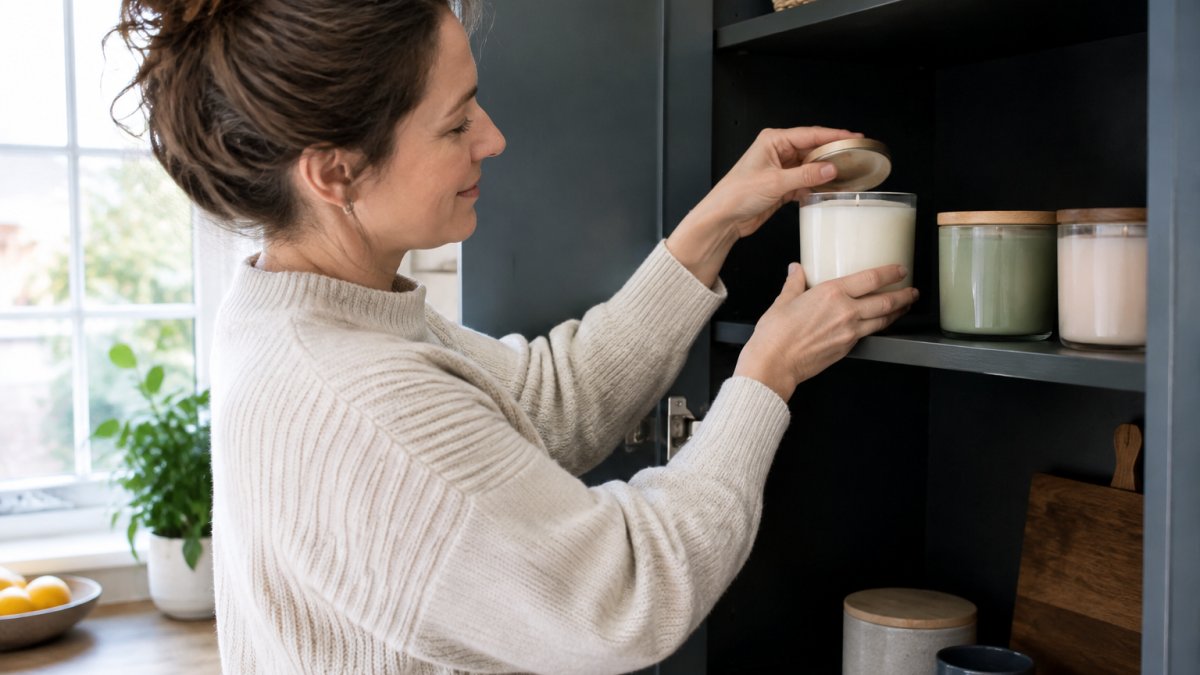
1. Keep the lid on. Fragrance oils are volatile, meaning they evaporate into the air even when the candle is not burning.
2. Keep it dark. Ultraviolet light breaks down fragrance compounds and can cause the wax to discolour.
3. Keep it cool and steady. Heat accelerates evaporation and causes wax to soften and re-solidify, which can create an uneven surface and a weaker scent.
**4.
A Practical Storage Routine
- Keep the lid firmly on between burns
- Store away from windows and radiators
- Avoid bathrooms, where heat and steam swing the temperature
How Long Do Scented Candles Last?
There is no single expiry date for a scented candle.
Wax type:
Packaging: A well-sealed jar with a tight lid preserves fragrance far better than an open tin or a wrapper-only candle.
Signs a candle is past its best:
- The wax looks dry or chalky
- The scent has faded even with the lid on
- The surface has cracked or pulled away from the glass
If you see these signs, the candle will still burn, but the hot throw will be weak.
Watch out: do not store candles in a warm car, a loft that overheats in summer, or a shed that freezes in winter.
If you are stocking up, it is worth browsing a scented candle worth storing properly so you are not preserving a dud. And if you are weighing up shelf life before buying, check the details on a large double-wick candle to see what you are getting.
How Long Do Scented Candles Last? Shelf Life and Burn Time
Signs a candle is past its best:
- The wax looks dry or chalky
- The scent has faded even with the lid on
- The surface has cracked or pulled away from the glass
If you're weighing up shelf life before buying, check the details on a large double-wick candle to see what you're getting.
Scent loss is rarely a mystery once you know what to look for. It's usually storage, wick care, or a candle that was never built to perform in the first place.
Frequently Asked Questions
Why do candles lose their fragrance over time?
Fragrance oils are volatile, so they slowly evaporate from the wax even when the candle is unlit. Exposure to air, light and warm temperatures speeds this up, and the scent notes most likely to disappear first are the lighter citrus and floral ones. A candle stored badly for a year can smell noticeably weaker than one kept cool and covered, which is why storage matters as much as the original fragrance load.
Why does my candle stop smelling while it is burning?
This is usually scent adaptation rather than true scent loss. Your nose adjusts to constant fragrance within minutes, so a candle that filled the room on lighting can seem to fade while it is still working. Other causes include a wick that is too small for the melt pool, tunnelling from a short first burn, or a room with strong airflow pulling scent away. Try stepping out of the room for ten minutes, then walking back in.
How should scented candles be stored to preserve their fragrance?
Keep candles in a cool, dark place away from radiators, windowsills and direct sunlight, and put the lid on between burns to limit air exposure. Aim for a steady temperature rather than a warm cupboard, and avoid storing them in bathrooms where steam and humidity fluctuate.
Do different wax types affect how strongly a candle smells?
Yes. Fragrance load matters just as much: a candle with a low fragrance percentage will smell faint once lit no matter how good it smells in the jar. At HappyNose Candles we use the highest fragrance load possible in natural soy wax and test each scent during development to confirm it fills a room.


